Jackal’s custom sniper rifle
The Day of the JackalThe Jackal’s custom sniper rifle is both a precision weapon and a concealment system, built to pass through searches in pieces and emerge where its user needs it. Hidden first beneath a car and later inside a crutch, it carries The Jackal from covert preparation to a firing position overlooking Charles de Gaulle’s ceremony. Its construction enables the attack; the President’s unexpected movement defeats the first shot, and the rifle remains lethal in the confrontation that follows.
Construction and Concealment
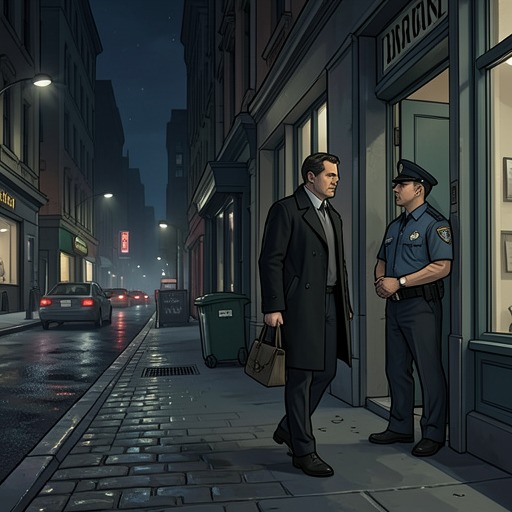
The rifle was designed to be transported as separate components rather than as a recognizable firearm. Its stock, breech, barrel, silencer and telescopic sight fitted into five steel tubes that looked like aluminium. The Jackal kept the tubes concealed beneath his car for sixty hours. Once he recovered them in a forest, he checked the vehicle for identifying evidence, drove it into a thicket of wild rhododendron and cut branches to hide the opening. He then packed the tubes into a suitcase with old clothes and a military greatcoat, carrying his equipment onward with the rest of his baggage.
The weapon’s final disguise was more elaborate: the parts were concealed inside a crutch. In the room prepared for the attack, The Jackal unscrewed the crutch section by section. Its rubber ferrule concealed percussion caps for the three remaining shells; other sections yielded the silencer, telescopic sight, breech and barrel. Steel rods concealed in the Y-shaped frame formed the rifle’s stock, while the padded armpit support became its shoulder-guard and contained the trigger. The parts were not simply hidden in the prop: the crutch itself supplied part of the assembled weapon’s structure.
The Jackal had also prepared ammunition for concealment and use. A black rubber stud held five explosive bullets. Before the attack, he removed two and extracted the small pencils of cordite from their noses, discarding the emptied cartridge cases. Three bullets remained. The preparation left him with limited ammunition but a compact load that could be carried through the security perimeter without presenting itself as a rifle.
Firing Position and Failed Shot
The Jackal assembled the weapon in a room overlooking the station forecourt, about 130 metres away. He kept back from the window and used the living-room table, stripped of its cloth and decorations, as a support for cushions that steadied the rifle. After assembling the breech, barrel, stock, shoulder-guard, silencer and trigger, he fitted the telescopic sight and tested the view across the sunlit square. He tracked a man marking out positions for the ceremony, then placed the three cartridges in a row and loaded the first into the breech. The rifle was ready before the ceremony began.
During the presentation, Charles de Gaulle leaned forward to kiss a veteran on both cheeks. The Jackal fired as the President’s head moved across the sightline. The bullet passed a fraction of an inch behind it and struck the softened tarmac instead. The ceremony continued without interruption: the band played on, and de Gaulle moved to the next veteran. The miss was not caused by a failure of the rifle or a faulty view; the target’s movement, at the instant of firing, carried his head clear of the bullet’s path.
The Jackal reacted by ejecting the spent cartridge and loading a second round from the table. That spare shot mattered because the first had not ended the attack, but it also gave the police a brief interval to close in. Claude Lebel reached the sixth floor and ordered a CRS officer to shoot through the locked door. The noise of the entry and the shot from inside brought the rifle into a close-range confrontation rather than the controlled long-distance attack for which it had been prepared.
Final Use and Significance
When Pierre Valremy entered the room ahead of Lebel, The Jackal rose from behind the table and fired from the hip. The bullet struck Valremy in the chest and exploded, inflicting fatal injuries. The rifle thus completed a second, very different function: after failing to hit its intended public target, it remained capable of killing an officer at close range. The contrast between the carefully arranged firing rest and the sudden shot from the hip marks the collapse of the plan into a direct struggle.
The weapon’s design connects the novel’s meticulous material preparations to the uncertainty they cannot eliminate. Steel tubes, a hidden car, disguised parts and a crutch allow The Jackal to carry a firing system through successive layers of concealment; the telescopic sight gives him a clear line to the ceremony, but cannot account for de Gaulle’s unplanned gesture. The rifle makes the assassination attempt possible without making its outcome certain. Its final shot, delivered against Valremy, underscores that the failed attempt does not make the object harmless: the rifle remains dangerous even after the original plan has been exposed and disrupted.